DASI: AI Property Analyzer
Redesigned and rebuilt the front end of a U.S. real estate investment app using Claude Code. Expanded the product into contractor matching and room visualisation. Contributed to a 20% increase in revenue across 25,000+ downloads.
Role
Product Design, Front-End Development
Year
2025
Platform
iOS, Android
Tools
Claude Code, Cursor, Xcode

Impact at a glance
Joined as the first and only product designer. Redesigned the product from research through to front-end code using AI coding tools, then identified and led two product expansion efforts.
Overview
 DASI is a property analysis app that helps real estate investors – including fix-and-flip investors, wholesalers and rental property buyers – assess deals faster, from estimating repair costs and after-repair value to reviewing comparable sales and deciding what offer makes sense.
When I joined, DASI had already proven demand through strong downloads, early revenue and a useful core product. The app had been built quickly by a small engineering team before I was brought in as the dedicated product designer. My role was to improve the core experience, support retention and identify opportunities for product growth.
I redesigned DASI from the ground up, rebuilt the iOS and Android front end in  React Native with Expo using
  Claude Code and created the design system directly in code. This work was grounded in analytics, user interviews and journey mapping, which shaped the core redesign and led to two product expansions:
 Contractor Network – a website where contractors could apply to join DASI as preferred local partners, so the app could recommend them to investors analysing properties in their area.
 Roomit – a separate app for room-level renovation planning, visualisation and sourcing materials and furniture for renovations, tested as a growth experiment beyond DASI's core audience.

Design
The Problem
A property opportunity can disappear before an investor has gathered every piece of information they would ideally want. Yet moving too quickly without a reliable financial picture can expose them to significant risk. Investors therefore need a way to move quickly with confidence, supported by trustworthy estimates of repair costs, realistic renovated value and an offer price that protects their target profit.
Before I joined DASI, the team had launched a deliberately simple MVP built around generating an initial property analysis. Users moved through a single guided flow from property input to results. This validated that investors wanted, used and were willing to pay for this core analysis, but the product remained extremely limited as it began to grow.
What remained unresolved was the longer decision-making process around the first analysis. Investors compare deals, revisit assumptions and return to the same property multiple times before deciding whether it is worth pursuing. The original app treated each analysis as a one-off task, with no easy way to return to previous work or compare one opportunity against another.

Research & Discovery
I reviewed product behaviour in  Google Analytics for Firebase and conducted user interviews to better understand how people were using the app and where the experience could be improved.
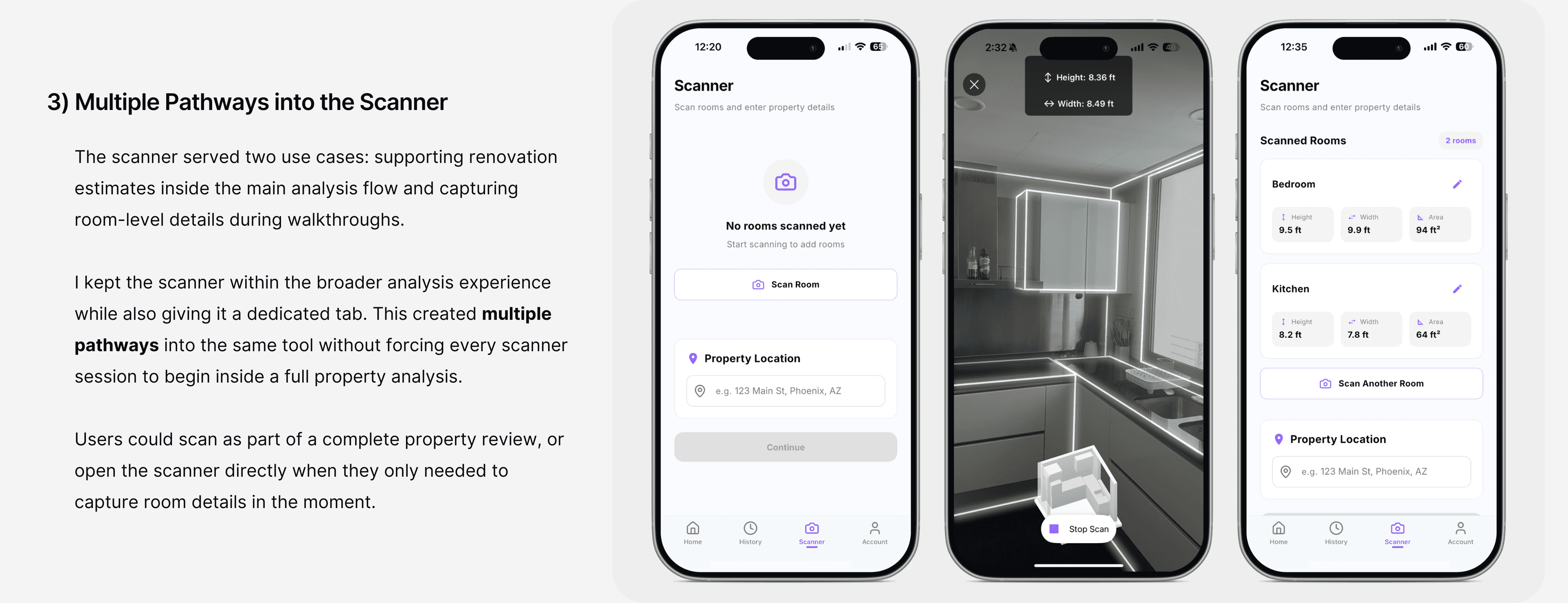
Analytics showed two patterns. Users were searching for the same properties multiple times, which suggested they were trying to return to past work that the app had not saved for them. Users also often left after using the room scanner, a camera-based tool for measuring rooms, mapping rough layouts and noting surfaces relevant to renovation. At first, we thought this might point to a technical issue. The scanner might have been breaking, the next screen might not have loaded or users might have been getting stuck after the scan.
Interviews clarified what was happening. Users were often using the scanner during property walkthroughs as a task in itself. They wanted to measure rooms and record relevant surfaces without always completing the wider property analysis flow. In the original app, however, the scanner still sat inside that broader flow. Interviews also revealed that some users were taking screenshots of result screens and saving them in folders on their phones. They were creating their own saved history because DASI did not preserve past analyses.
The product stopped where the workflow continued. Through journey mapping and interview follow-ups, it became clear that investors needed support beyond the initial analysis. After deciding a deal looked promising, they still had to find contractors and plan renovation scope, steps DASI didn't yet address.

Design Goals
From these insights, I went into the redesign with three goals.
Give users more control. DASI needed clear entry points for different tasks instead of one prescribed path for every session.
Make DASI useful across sessions. The product needed saved history so users could return to previous analyses and compare deals over time.
Extend the product beyond analysis. Investors needed clearer paths from analysis into action, especially around contractor support and room-level renovation planning.
The Redesign:
1) A More Flexible App Structure
The original app centred on one main property search flow. I introduced bottom navigation with four clear sections – Home, History, Scanner and Account – so users could choose the path that matched their intent.

The new Home screen became both a starting point and a return point. Users could begin a new analysis, while recent searches surfaced saved History items for quick access. This was made possible by working closely with the engineering team to support saved analyses, so users no longer had to repeat searches or rely on screenshots.
The structural redesign also created an opportunity to rethink the app's visual experience from the ground up. Because the previous version had only supported dark mode, which had weakened retention and prompted user complaints, I designed the new interface in light mode and made it the default. By building the redesign through a design system with adaptable colour styles and components, I could then offer dark mode as a consistent alternative for users who preferred it.

Development
Building the Front End
The original app had been built around a single linear flow. The redesign introduced bottom navigation, saved history and multiple entry points, a fundamentally different architecture. Adapting the existing front end to support that structure would have been slower and more fragile than starting fresh. I advocated for rebuilding the interface and took responsibility for much of its implementation.
I had been building with AI coding tools through side projects (see, for example, Zhiyin: Learn Chinese with Music), and recognised that on a team this small, a designer who could also build would make a real difference to how fast we could move. After the team agreed, I built much of the redesigned iOS and Android interface in React Native with Expo using Claude Code, then worked with the developers as they integrated the backend, reviewed the implementation and prepared it for production.


Product Expansion
Contractor Network
A property analysis could tell users whether a renovation opportunity looked worthwhile, but it could not help them take the next practical step. My interviews and journey mapping showed that many users left this part of the journey needing to find a contractor independently.
I created Contractor Network to close that gap. Using Claude Code, I designed a dedicated website and application flow for contractors to join the network, then led the initial sourcing effort through contractor recommendations from DASI users and outreach in relevant  Facebook communities across the U.S.
The goal was not to create a separate product, but to extend DASI into the next stage of the user journey. I worked with the dev team to bring approved local contractors into the property analysis experience, allowing users to find potential renovation partners as soon as they identified a viable opportunity.

Roomit
My role at DASI included identifying where the product could expand. Research had surfaced interest in room-level renovation planning, visualising outcomes and sourcing materials, but this went well beyond DASI's core use case of deal analysis. Rather than force it into the existing app, we spun it out as a separate experiment called Roomit.
Users could photograph a room and receive multiple AI-generated renovation visualisations. Each visualisation was connected to a sourcing layer: specific materials, finishes and furniture that users could review and purchase through the app. Building this required significant backend engineering, including room-scanning, AI image generation and real-time product matching. I built the front end using Claude Code, while engineers developed the backend systems.
Following the same approach as DASI's initial launch, we shipped Roomit as a single-flow MVP. One path, no tab bar, minimal scope. The goal was to validate demand before committing to a fuller product.

Reflection
Working on an established product gave me something a greenfield project cannot: real user behaviour to design around. I did not have to guess what users needed. I could see it in repeated searches, saved screenshots and scanner sessions used outside the intended flow.
I was also DASI's first and only designer, which meant establishing how design would contribute to the product while carrying responsibility for the work myself. One of the most important lessons was learning not to design first and seek agreement afterwards. Instead, I had to communicate the importance of major decisions early, align the team around a direction and then translate that shared understanding into design. That process made me feel less isolated in the work and made the decisions themselves stronger. It also required a deeper command of the product across user behaviour, research, code and strategy, strengthening both my design practice and my product judgement.